Watch the video update: https://youtu.be/K97VqrnI5gQ
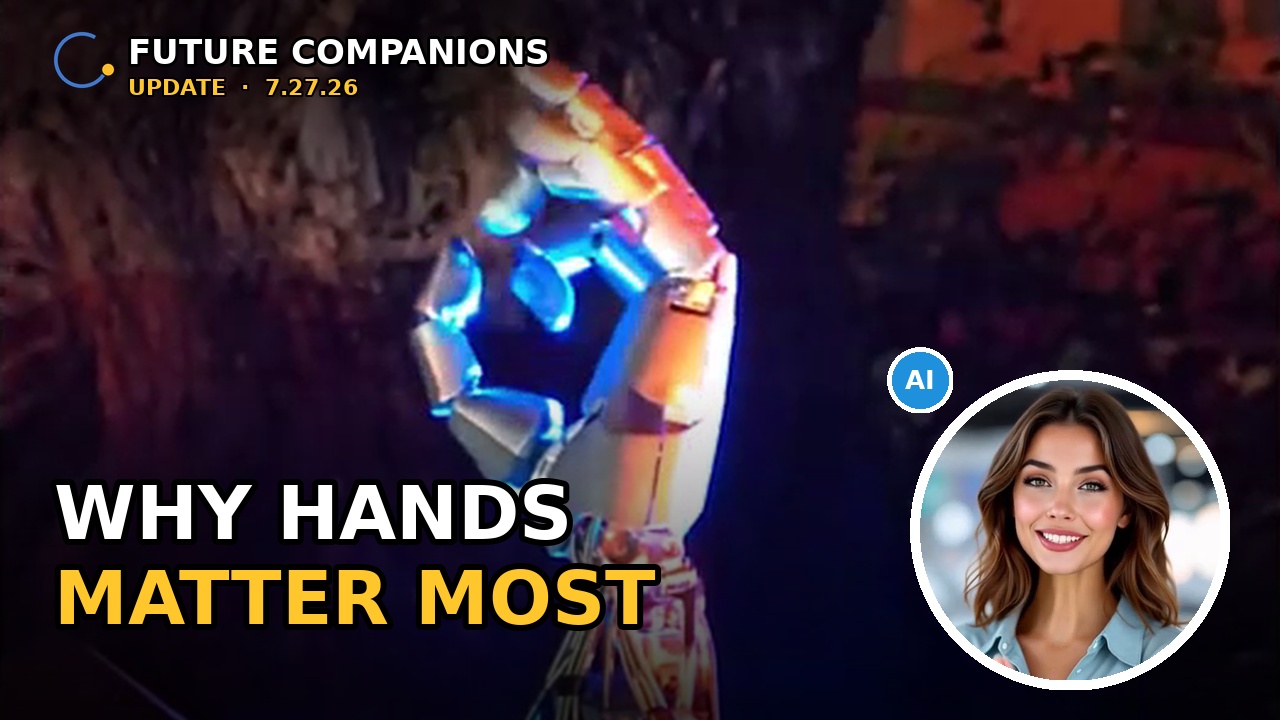
Most people look at a home robot and notice the face, the voice, or whether it can walk. For seniors — and for anyone thinking seriously about what a companion robot needs to actually do — one of the most important parts may be the hand.
The hand is where help becomes real. It’s what would pick up a glass of water, open a drawer, hold a pan, wipe a counter, or steady someone getting out of a chair. Someday, it may even be what offers comfort — just holding someone’s hand when they feel alone. A robot can have the warmest voice in the world, but if it can’t safely pick up a pill bottle or catch someone who’s stumbling, it isn’t ready to help with daily living.
That’s why the hand has quietly become one of the most competitive — and most difficult — problems in robotics right now. Three companies are taking notably different approaches to it: Tesla, Figure, and a fast-rising Chinese firm called Wuji Tech.
Why the Hand Is Harder Than It Looks
Strength alone isn’t the goal. A hand built for senior care needs gentle grip, pressure sensing, balance, and the judgment to handle fragile objects — and fragile people — safely. That combination (power and delicacy, in something roughly the size and shape of a human hand) is a genuinely hard engineering problem. Elon Musk has said Optimus’s hand represents roughly 60% of the robot’s overall engineering difficulty — harder, in his words, than the Cybertruck or Model X, somewhere between Model X and Starship.
Tesla: Moving the Muscle Out of the Hand
Tesla’s newest Optimus design (often referred to as V3) takes a page from human anatomy. Instead of packing motors into the hand itself, Tesla moved them into the forearm — closer to how a human forearm’s muscles pull tendons that move the fingers.
Recently published patents describe a tendon-driven system with 22 total degrees of freedom: four per finger across five fingers, plus two in the wrist. Three flexible cables per finger run from forearm actuators, through the wrist, into the finger segments, with internal channels routing them so each joint can bend independently without unwanted motion elsewhere in the hand. The wrist itself uses a cable-transition design that shifts from side-by-side to stacked cable routing, which reduces friction and “crosstalk” between cables during multi-axis movement — a detail that matters if a robot needs to do something as simple as turning a doorknob while adjusting its grip.
Notably, the patents also emphasize manufacturability: simplified, stackable parts designed to be built at scale, not just in a lab.
Figure: Teaching the Hand to Feel
Figure’s approach to its Figure 03 robot leans hardest into touch itself. The company built proprietary tactile sensors for each fingertip that can detect forces as small as three grams — sensitive enough, Figure says, to register the weight of a paperclip resting on a finger. That sensitivity lets the system tell the difference between a secure grip and an object starting to slip, which is exactly the kind of judgment call a hand would need to make before it drops a coffee cup or grips someone’s arm too hard while helping them stand.
Figure paired that sensing with softer, more adaptive fingertips that increase surface contact for more stable grasping across different shapes and materials — from small metal parts to soft, deformable objects. Figure has been explicit that Figure 03 is being designed with home environments in mind, even if it hasn’t spelled out caregiving use cases specifically yet.
Wuji Tech: Small, Light, and Surprisingly Affordable
The most unexpected entrant may be Wuji Tech, a Chinese robotics company whose Wuji Hand takes a different mechanical bet entirely. Rather than routing tendons from forearm motors, Wuji embeds micro-actuators directly inside each finger segment — a “direct-drive” approach. One robotics expert described it as turning each finger into “basically like tiny little robots.”
The specs are notable: 20 degrees of freedom, a skeleton weighing under 600 grams, 15 newtons of fingertip force, and a 10kg static grasp load — reportedly at a price point near $5,500, a fraction of what custom humanoid hardware typically costs. Independent experts who tested it called it “remarkably robust” and praised its mechanical reliability, noting that direct-drive designs tend to be more predictable than complex tendon systems, which narrows the gap between how a hand performs in simulation versus the real world. They also flagged real limitations: the fingers are more uniform in length than a human hand, the thumb lacks the subtle rotation needed for fine tasks like tying a shoelace, and the base model doesn’t yet have advanced tactile sensing beyond position tracking.
What This Means for a Future Companion
None of these three approaches has “solved” the hand yet — and that’s the honest takeaway. Tesla is betting on anatomy-inspired tendon mechanics built for mass production. Figure is betting on touch sensitivity as the key to safe, adaptive grip. Wuji Tech is betting that a simpler, direct-drive design can get dexterous hands into the world faster and cheaper, even if fine motor control still needs work.
For a future companion robot meant to help someone age safely at home, the winning hand will likely need to borrow from all three: the reach and durability to be useful for years, the touch sensitivity to know when to let go, and a cost structure that doesn’t put it permanently out of reach for the families who need it most.
We’re not there yet. A good robotic hand still needs a smart brain behind it — knowing when to reach for the glass, not just how. But this is one of the areas worth watching closely, because a future companion robot won’t just talk to us. It will need to touch the world carefully.
Future Companions explores how AI and robotic companions might support seniors and people who need help with daily living — without losing the human side of care. New content every 1-2 weeks.
Sources:
- New Tesla Patents Reveal How Optimus V3 Hand Mimics Human Muscles and Tendons — Drive Tesla
- Tesla Optimus V3 hand and arm details revealed in new patents — Teslarati
- Introducing Figure 03 — Figure.ai
- Experts Weigh In on Wuji Tech’s Robotic Hand: A “Remarkably Robust” Direct-Drive Contender — Humanoids Daily
- Wuji Hand — Wuji Technology